OPINION · LADERA RANCH
Ladera Fights to Throw Out the Rubber Stamp
A record number of residents voted for new voices on the LARMAC board. One week later, the board showed what it thought of the result.
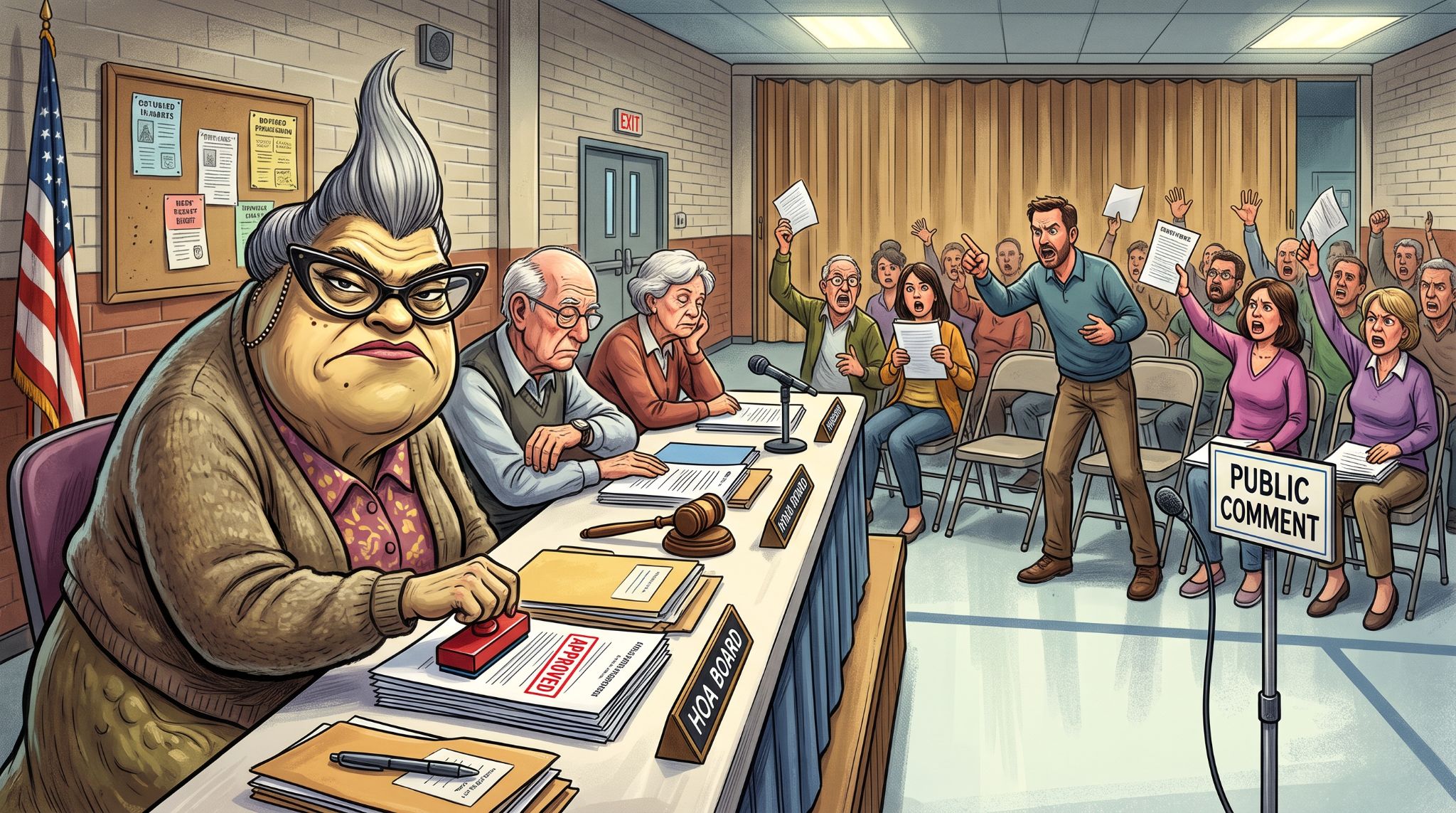
I spent two years on the LARMAC board, and most of what I remember is people jumping through hoops just to feel heard.
Local business owners begging for logic to prevail over antiquated architectural bylaws. A 12-year-old boy, visibly nervous, asking a room full of adult strangers whether he could set up a community repair station to fix his neighbors' bikes. Residents going through thin times, asking for a little grace while they scraped together the money for upgrades the association needed them to make to their homes.
Then came the night grief-stricken parents stood up to recount the worst days of their lives and ask for answers. They too got a three-minute timer, followed up by a tone-deaf request for more dog poop bag dispensers.
That was the night I stopped believing our process could be fixed from the inside.
Why I ran
I sat through many four- and sometimes five-hour open sessions, closed sessions, and landscaping subcommittees. I ran because I wanted Ladera in the 21st century, with technology that lets residents see decisions before they are made and weigh in while it still counts, instead of going on a scavenger hunt through a stagnant website for the receipts after the fact. In full disclosure: I also wanted a better tended cul-de-sac.
I sat through debates on whether a clubhouse ice maker had one more year in it, the unwelcome return of a fungus beetle, and acacia removal strategies. Yet topics that addressed whether our largest contracts are ever put out to competitive bid, a question touching every household, lived in documents almost nobody opens.
Being heard has an admission price. You have to know where the agenda lives, when it posts, which blandly worded line might matter to your family, and what you can still do before the vote. Most residents understandably are busy with work, dinner and children and reasonably expect important things to be explained plainly and well in advance.
The printing press
So I built The Ladera Bubble. The name meant to connote the transparency of a bubble and for the close knit community who lives inside of it. I offered it to LARMAC as a just-add-water platform: one app where any resident could raise what mattered to them (pesticides, say) and, if enough neighbors agreed, the issue would reach the board with real numbers behind it. No million-dollar tech budget. Just some good ol' vibe-coded meritocracy, about as hard to use as the wallet on your iPhone.
I was told to have it "agendized."
I had assumed I was dealing with well-meaning Luddites, stuck in an analog world and waiting for a resident technophile in a cape. I was wrong. I might as well have proposed text messaging for the DMV. More communication was not wanted. The system rests on a belief I heard voiced at more than one meeting: the board knows what is best for the residents.
That belief is old. Eighteenth-century monarchs had a motto for it: everything for the people, nothing by the people. It always presents itself as a duty and never as self-interest.
The establishment was unimpressed with my printing press. What followed was not "what a fantastic way to hear from our residents" but a round of back-channel emails and phone calls. Fellow directors wanted to "chat," or "break bread," about my "participation," and they did not mean a lack of it. As I understood it, I was about to be disciplined, and nobody had put a word of it in writing.
My own part in this deserves a paragraph. I ran a startup for a decade before I sat on this board, and getting to see the inside of a real, live institution fascinated me. It also showed me I was not built for one. I am ready, fire, aim. A board is measure twice, cut once, then table it until next month. The instincts that were assets in my startup had become a nuisance to the people sitting beside me, and the procedural monotony ran against my grain at every meeting. There was no taste at LARMAC for my viva la revolución, and the revolution, in fairness, had no patience for LARMAC.
So I resigned on November 4, the day the election results came in, to make room for people better suited to bridging that divide. The timing was deliberate and, I admit, optimistic: the newly elected directors could have a say in who filled my seat.
What happened to the seat
The vacancy surfaced as one line on the November 11 agenda: "Consideration of Approval of Appointment to Fill Vacant Board of Directors Seat." It did not say who had left or how a replacement would be chosen. Nobody should have had to investigate to learn that.
Here is the election the board was asked to honor:
Among individual homeowners:
Jeff Moll received 783 votes, Neil Anderson 424, Spencer Ririe 364, Chris Carter 136 and Ryan Vallone 103. DMB Ladera cast 378 votes for Carter and 378 votes for Vallone.
In a firsthand account posted to The Ladera Ranch Neighbors on November 11 at 10:54 p.m., Valerie Anderson described the incumbent directors as supporting Vallone for the vacant seat. According to Anderson, Moll moved to appoint Neil Anderson in recognition of the residents’ vote, but his motion died for lack of a second. She reported that Lee said much of the turnout was probably driven by media frenzy about pesticides and misinformation on social media. She interpreted Carter’s comments as suggesting that the board knew better than the people who elected it.
According to Anderson’s account, residents pointed to Section 2.5(b) of the bylaws, which lets the president call a membership election to fill a vacancy. The board declined. They pointed to Section 2.5(c), which requires a meeting once members holding 5 percent of the voting power petition for one, and asked for a week to gather signatures. The board declined that too.
Anderson reported that, in the end, on the advice of the association's attorney, the board appointed Henry Shahinian, until then a non-voting officer, to the voting seat. Neil Anderson and Vallone were given non-voting roles.
November 4, 2026 election
| Candidate | Resident votes | DMB votes | Total |
|---|---|---|---|
| Jeff Moll | 783 | 0 | 783 |
| Neil Anderson | 424 | 0 | 424 |
| Spencer Ririe | 364 | 0 | 364 |
| Jenny Granero | 316 | 0 | 316 |
| Kurt Randle | 166 | 0 | 166 |
| Chris Carter | 136 | 378 | 514 |
| Ryan Vallone | 103 | 378 | 481 |
Vote totals checked against LARMAC’s official 2026 neighborhood voting breakdown; “resident votes” means total votes minus apartment-property-owner votes. LARMAC’s 2020 election FAQ identified DMB Ladera as owning 378 assessment-paying apartment units. That ownership figure is historical; the 2026 breakdown lists apartment neighborhoods and votes, not their owners.
The relationships behind the contracts
The stakes extend beyond who occupies a board seat. Those directors also oversee the companies residents pay to manage and maintain Ladera. Understanding those relationships starts with how the community was built.
Rancho Mission Viejo, the O’Neill–Avery–Moiso family’s ranching and development business, helped develop Ladera Ranch. A 2004 filing with the Securities and Exchange Commission identifies DMB Ladera as a venture owned by a Rancho Mission Viejo affiliate and DMB Consolidated Holdings, an Arizona company. The record describes a partnership between the family’s development interests and DMB, rather than ownership of DMB itself by the family. Rancho Mission Viejo describes that development history in its company background.
The landscape relationship reaches back to Ladera’s early years. O’Connell Landscape Maintenance says in its Ladera Ranch case study that it has served LARMAC since 1999, and LARMAC’s July 2026 update identifies O’Connell as its landscape contractor.
There is also a documented civic connection between the developer and the landscape company’s founder. Mission San Juan Capistrano’s biography of George O’Connell says he joined its preservation foundation board at Tony Moiso’s request. The Mission’s 2009–10 annual report records O’Connell succeeding Moiso as president, with Moiso remaining on the board. Shared charitable service does not establish that anyone influenced a LARMAC contract.
FirstService Residential has a separate role: managing the community’s daily operations under the board’s supervision, as LARMAC’s governance FAQ explains. That management contract is distinct from O’Connell’s landscape contract. The records reviewed here do not establish a comparable personal or ownership connection between FirstService and DMB or the Moiso family.
What continuity means for residents
For a large property owner, familiar directors and established contractors can offer predictable budgets, maintenance standards and operating practices. New directors may ask for competing proposals or question arrangements their predecessors accepted. That is a plausible reason to value continuity; it is not an established explanation of DMB’s votes. And an owner that pays assessments also has an interest in getting good value from those contracts.
For the contractors, keeping the work means keeping the revenue. If a board continues existing arrangements, the vendors avoid the risk of losing the work through competition. But reelecting incumbents does not automatically renew a contract, and we have not established that DMB backed candidates to protect either company, that directors promised to preserve their contracts, or that the companies coordinated their actions.
What residents can examine is the board’s record. LARMAC’s own description of a director’s responsibilities includes negotiating and approving contracts, budgets and assessment rates. The people in those seats decide how closely to scrutinize the spending and whether to seek alternatives.
For two years I pushed LARMAC to put its major contracts out for competitive bid: management, landscaping, maintenance. As far as I could determine as a director, the management contract has not been competitively bid in roughly twenty years. Bidding every few years is routine diligence. It accuses no vendor of anything, and I have no quarrel with the people doing the work. It is how an association this size protects your money.
Residents should be able to see when each major contract was last bid, how competing proposals were evaluated, and what relevant relationships were disclosed. An incumbent contractor may still be the best choice. A documented comparison gives that conclusion something stronger than familiarity to stand on.
What you can do this week
Information that arrives too late to act on is not transparent. It is a receipt.
That is why The Ladera Bubble exists: to put local decisions in front of you, in plain English, while there is still time to do something about them.
The bylaws give members a tool, but its scope matters. Section 2.5 allows members holding at least 5 percent of LARMAC’s voting power to require a replacement meeting when a board vacancy exists. Separately, California Corporations Code Section 7510(e) allows 5 percent or more of the members to call a special meeting for a lawful purpose. A petition calls for a process; it does not itself remove a director or seat a candidate. If the vacancy has already been filled, the replacement-meeting provision is not an automatic way to undo the appointment. Add your name at thebubbleladera.com if you want follow-up about a properly framed paper petition. The requested action, member eligibility and signature requirements must be settled before it is circulated as a formal demand.
A community should not have to fill a room every month to prove it deserves a say.
Updated November 13, 2026: This article has been corrected to distinguish apartment votes from the historical unit-ownership figure and to identify Valerie Anderson’s November 11 account as the source of the meeting narrative. The description of Carter’s comments reflects Anderson’s interpretation. The petition section now distinguishes a vacancy replacement meeting from a general special meeting and clarifies that signatures alone do not change the board’s membership. The contracting section now presents the documented development, contractor and foundation relationships before discussing possible incentives for continuity. It distinguishes those facts from unproven motives.


Be the first to comment.